Most high school students never imagine that a project built in an agricultural mechanics shop could one day help protect the nation's livestock industry. Fewer expect to see something they designed and fabricated recognized by government officials and used in efforts to strengthen American agriculture.
For members of Samuel V. Champion FFA's agricultural mechanics program in Boerne, Texas, that became reality.
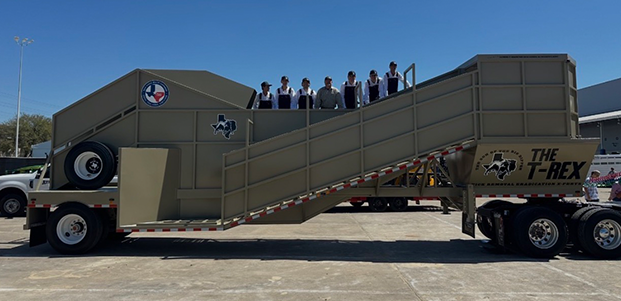
Over the last year, chapter members, under the direction of advisor Dorman Vick, designed and built the T-REX, or Tick Removal Eradication X-perts, a massive mobile dipping vat created to support efforts to protect the U.S. cattle industry from livestock pests and disease threats.
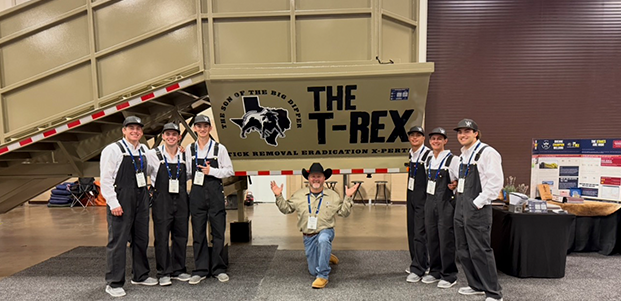
The project directly supports agricultural biosecurity efforts and represents months of engineering, planning, fabrication and teamwork. For the students involved, it was far more than a welding project.
"The most challenging aspect was designing and building a system that was both mobile and durable enough for agricultural use while still meeting the requirements set before us by the Texas Animal Health Commission (TAHC)," student Cade Vick said. "So being able to overcome those immense hurdles through communication, working as a team, brainstorming, and designing through Google SketchUp, helped all of us to grow stronger as a team and got us across the finish line with a project that will hold up for generations to come."
The technical skills students developed were significant, but many say the relationships built throughout the process were equally impactful.
"I think what's made me the most proud throughout the ups and downs of this project was growing the relationships with my five other friends along with Mr. Vick," Roman Beetz said. "Additionally, using that growth through eight months of hard work to bond over the smallest things. Those small things made each day more worth it, and those moments directly correlated to increased teamwork that led to produce something so special and meaningful to all of us, which is something that over the course of my life I'll never be any less proud of."
The project attracted attention from agricultural leaders across the country.
"The Southwest Cattle Raisers Association found out about the build and invited us to the Cattle Convention and Expo in Fort Worth," Vick said. "It was another historic thing that had never happened before. That's where things really, really got awesome."
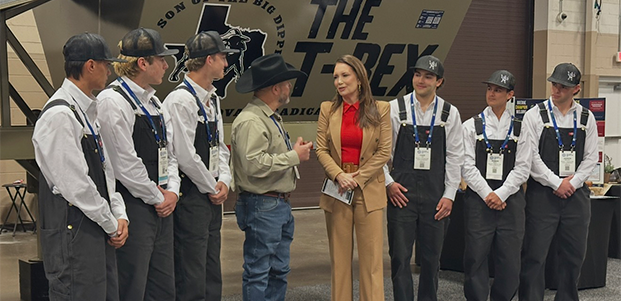
U.S. Secretary of Agriculture Brooke Rollins was in attendance at the convention and greeted the students with open arms.
"Secretary Brooke Rollins spent a ton of time with us, and even got on [the T-REX] with high heels on," Vick said. "She said that she was taking us to Washington, D.C., for the world to see these kids' incredible project."
The project went national much quicker than anyone planned.
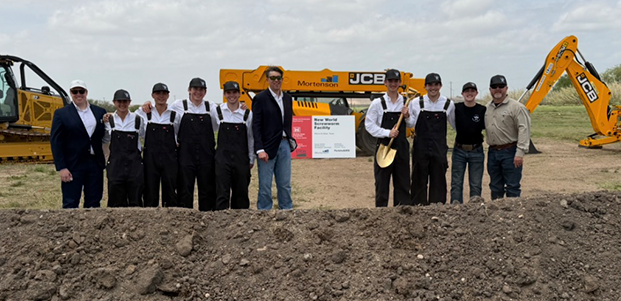
Shortly after the convention, Vick received a phone call from Washington, D.C., informing him that he and his students along with the T-REX had been invited to attend the groundbreaking ceremony for the New World screwworm facility at Moore Air Force Base in South Texas .
At the ceremony, Secretary Rollins asked the students and Vick to stand and be recognized for their work and the role the T-REX will play in protecting American agriculture.
"It's going to save America, because left unchecked, the screwworm will be devastating to the cattle industry," Vick said. "Our cattle numbers are already lower than they've been since the 1950s. It was a very powerful moment to be there. I'm excited that she recognizes and sees the value in what these kids have done."
The recognition will continue this summer when Rollins hosts the students and Vick in
Washington, D.C., as part of the Great American State Fair. While the T-REX itself will remain in Texas as it is prepared for deployment and use in ongoing livestock protection efforts, the students who designed and built the project will be recognized on a national stage.
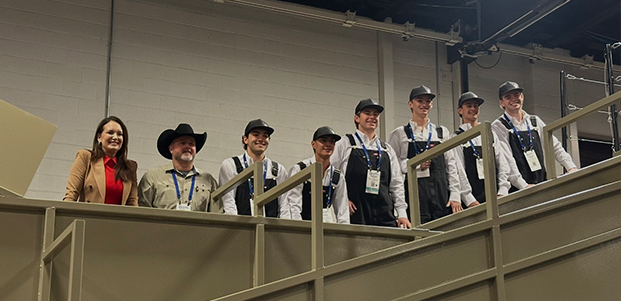
For Vick, the invitation represents something much bigger than a single project.
"To have these students recognized at the national level for work they completed in an agricultural mechanics shop is incredible," Vick said. "They're getting to see that what they do can have an impact far beyond our community."
For the students, the opportunity to represent Texas agricultural education in the nation's capital serves as another reminder that the skills they developed through the project can create meaningful change across the country.
While the T-REX brought national attention to the program, the story actually began nearly two decades ago with a connection that would change the course of Champion FFA's agricultural mechanics program.
Through the planning of an agriculture mechanics project in 2007, Vick was connected to Dr. Matt Pound with the USDA through multiple mutual friends. Dr. Pound was a leader in fever tick research at the USDA ARS Knipling-Bushland US Livestock Insects Research Laboratory in Kerrville, Texas.
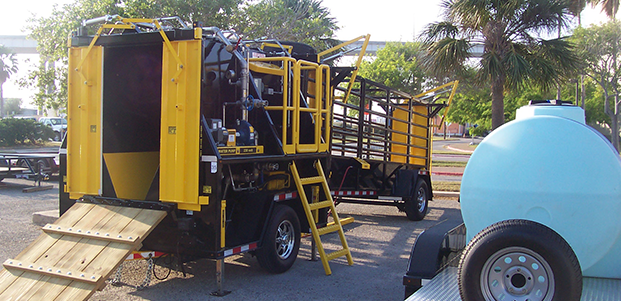
Dr. Pound had already started building capture setups in the Kerr Wildlife Management Area in Kerrville, Texas. Vick and his students began working with the doctor to create ways to capture deer more efficiently.
"To my knowledge, we developed the first ever swing-away gooseneck nose on a trailer that you pull a pin and the whole nose swings out of the way for a 40-foot rotunda to be set up," Vick said. "It has a series of boxes on the trailer leading up to a lift chute to be able to lift the deer up. Then four people can work on that deer, check it for fever ticks, ear tag it, cut the horns off, and then the lift safely lowers them back down."
The Mobile Deer Capture Trailer marked the beginning of a partnership that would eventually place students at the center of projects with national significance.
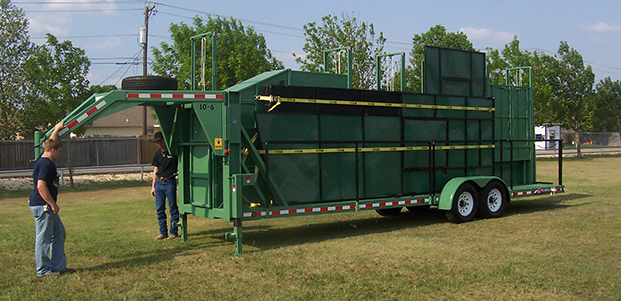
After the success of the Mobile Deer Capture Trailer, Dr. Pound connected Vick with another USDA official, Ed Bowers. Vick and five of his students traveled to Laredo to learn about their next mission — building a mobile dipping vat for cattle, later called the Big Dipper.
"We came back in 2009 and 2010 and built the first mobile dipping vat," Vick said. "We literally lived at the shop to be able to get that done, because it weighs nearly 25,000 pounds empty. It's massive to say the least. The sheer amount of welding on it is mind-boggling."
Vick said that both the Mobile Deer Capture Trailer and the Big Dipper were built on handshake agreements with the federal government. Upon the third project in 2010-2011, a Mobile Scratch and Spray Unit, an official contract was implemented.
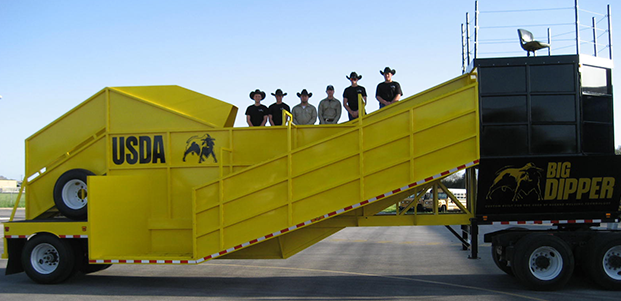
Years later, the impact of those projects was still being felt.
In early 2025, the state of Texas reached out to Vick to see if his students would build another mobile dipping vat like the Big Dipper. Vick initially thought the call was a hoax.
"They left a message that the Big Dipper was still going, and that it had outlived industry built ones," Vick said. "It was holding the Northern Line for the fever tick, and the state of Texas wanted us to build another one. I'm thinking, 'somebody is messing with me.'"
Vick instructed the callers to provide a detailed proposal outlining what they were looking for. When a multiple-page document, complete with photos and specifications, landed in his inbox, he realized his students were about to embark on another historic project.
That project became the T-REX.
For Vick, the national recognition and government partnerships are impressive, but the true impact can be measured in the students who have passed through the program.
"Morgan Burkett was a 2017 graduate and was in the top five in her class," Vick said. "[She] actually signed up for the course by accident. She went on to Purdue University, and she's working for Polaris as a development engineer. Mia Carolla is a 2015 graduate and is now a research engineer for the U.S. Air Force. She went on to Texas A&M University and is working on her doctorate while she's working for the Air Force."
Those stories, Vick said, are proof that the lessons learned in an agricultural mechanics shop can extend far beyond welding and fabrication.
"It's seeing lives get changed, seeing kids have a why, a purpose, because we're built pretty simply," Vick said. "We want discipline, we want love, and we want direction, and when we give people that, it's just incredible to watch the mountains they can climb."